
Flood Resilient Bathroom Renovation: A Planning Guide
Redoing your bathroom or laundry doesn’t happen often. When it does, you get to choose almost everything that goes into the room.
If your home is in a flood area, those choices matter more. They can change what happens if water ever gets inside.
The NSW Government has a simple goal for flood-safe homes. It wants floods to do less harm, and it wants families to get back home sooner. Think of it this way. After a flood, you could be starting again from nothing. Or you could clean up and move back in. Good planning helps you aim for the second one.
This guide is for people who live in Albion Park Rail, Oak Flats, Albion Park and Flinders. All four suburbs are inside areas that Shellharbour City Council has studied for flooding. You might know this already. You might even remember the big flood in March 2011, which caused damage all over the City of Shellharbour.
We’ll be honest with you. Thinking about floods isn’t fun when you’re excited about new tiles. But a flood resilient bathroom renovation starts with good facts, not worry. In this guide, we’ll show you how Council’s flood studies cover these suburbs and how to check your own home. We’ll also explain what “wetproofing” means and what to talk about with your renovator before any work starts.

What makes a bathroom or laundry more flood resilient?
A flood-resilient bathroom or laundry uses wetproofing. Wetproofing means picking materials and building methods that cope with water better. They get less damaged, and they’re easier to clean up. The NSW Reconstruction Authority suggests these ideas for the whole home:
- Cabinets that hang on the wall, and skirting boards you can take off, made from materials that resist water
- A bath that stands on its own (a freestanding bath)
- Power points and appliances placed as high as makes sense
- Tough materials like fibre cement sheeting and tiles with epoxy grout
These ideas come from the NSW Government. They were written for fixing homes after a flood. They are not Shellharbour Council rules. Our advice? Don’t wait for a flood to think about them. A planned renovation is your chance to make these choices early.
Why flood planning matters for renovations in Albion Park Rail, Oak Flats, Albion Park and Flinders
Shellharbour City Council has studied flooding in the areas around these suburbs. Each suburb is inside at least one study area.
| Suburb | Council flood study area(s) |
|---|---|
| Albion Park | Macquarie Rivulet; Horsley Creek |
| Albion Park Rail | Macquarie Rivulet (northern areas); Horsley Creek |
| Oak Flats | Lake Illawarra, Mt Warrigal & Oak Flats; Horsley Creek (part) |
| Flinders | Elliott Lake – Little Lake |
Floodwater can come from more than one place. Around Oak Flats, Council says there are two causes. One is Lake Illawarra rising. The other is heavy rain that sends dangerous stormwater running over the ground. Further down Horsley Creek, flooding is also affected by the lake level. Sand that builds up where the creek meets the lake plays a part too.
This has happened before. In March 2011, a huge amount of rain caused major flooding. It did damage right across the City of Shellharbour.
Here’s the part many people miss. Being inside a flood study area does not tell you about your own home. Two houses in the same suburb can be very different. To know about your place, you need information from Council about your property. That’s the next step.
Step one: check your property’s flood information with Council
If we could give you just one piece of advice, it would be this: check your flood information before you pick a single tile.
Shellharbour City Council will send you a letter about flooding at your property. You just fill in a request form. You can use the letter to understand your risk and to help plan your new room.
Here’s how it works:
- Get the form. Council’s flood level information request form comes as a PDF, or you can apply online.
- Send your request. Fill in the form with your property address.
- Use the letter when you plan. Keep it close by when you make design choices and talk to your renovator.
Even if you checked years ago, check again. Flood maps change over time. When Council finishes new flood studies, more land that can flood gets found and mapped. For example, Council adopted the Horsley Creek Flood Risk Management Study & Plan on 28 October 2025.
So don’t rely on what you heard when you bought the house. Ask for your home’s current flood information first. It’s one small step, and it’s best done before your design is locked in.
Wetproofing: the idea behind a flood-resilient bathroom
Let’s clear up a common mix-up. Flood resilience is not about keeping all water out of your home. It’s about how well your home copes if water does get in.
The NSW Government’s guide to flood-resilient homes calls this idea wetproofing. Wetproofing means using materials and building methods that can handle getting wet. They get less damaged, and clean-up is easier. The goal is to make future floods do less harm and help families get home sooner.
The NSW guide was written for fixing homes after a flood. We like to look at it another way. A planned renovation lets you make the same smart choices before anything goes wrong, while the room is already being rebuilt.
Keep in mind: Wetproofing is about getting back on your feet. It helps a room cope with water. It is not a promise that a room won’t be damaged in a flood.
Flood-resilient choices for your bathroom and laundry
Did your Council letter show your property can be affected by flooding? Then these are the choices to talk about with your renovator. The NSW guide covers the whole house. We’ve picked out the parts that fit your bathroom and laundry.
Wall linings and floors
The NSW guide lists fibre cement sheeting and tiles with epoxy grout as flood-resilient materials. Fibre cement sheeting is a type of wall board. Epoxy grout is a type of grout, the filler that goes between tiles. Both can be used on walls and floors in your new room. If you’re comparing what’s out there, have a look at our tiling and flooring options.
Vanities, cabinetry and skirting
The guide suggests cabinets that hang on the wall, plus skirting boards you can remove. Both should be made from materials that resist water. In a bathroom, this can mean your vanity. In a laundry, it can mean your cupboards and storage. Our tip: if you like the look of a wall-hung vanity anyway, this is a good reason to go for it.
The bath
The NSW guide lists a freestanding bath as a flood-resilient choice. If a bath is on your wish list, ask your renovator about this option.
Power points and appliances (especially in the laundry)
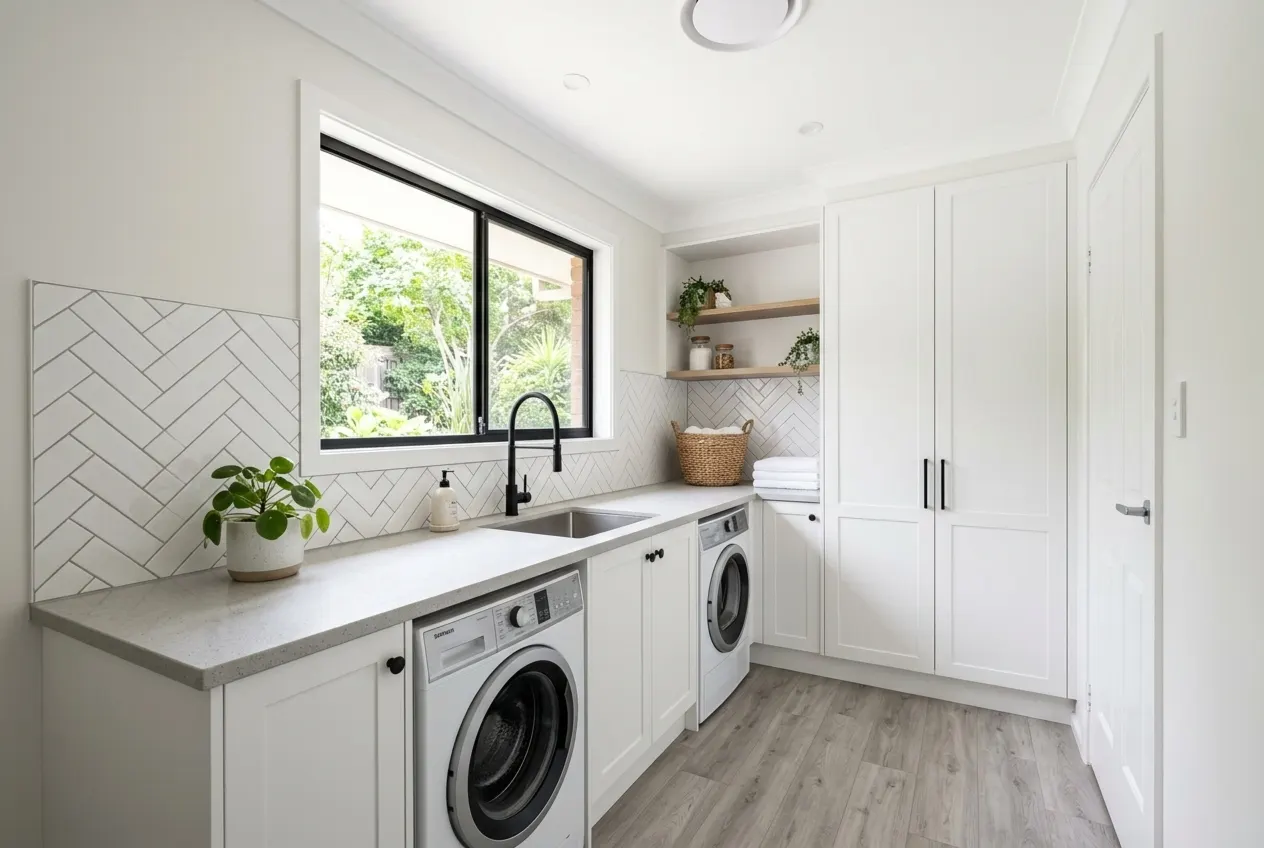
The guide says to put power points and appliances as high as makes sense. Keep this in mind if you’re planning a laundry renovation. Laundries are often full of washing machines, dryers and power points, so it’s worth thinking about heights early.
| Choice | What the NSW guide says |
|---|---|
| Wall linings | Fibre cement sheeting is listed as a flood-resilient material |
| Tiles | Tiles with epoxy grout are listed as a flood-resilient material |
| Cabinets | Use wall-hung cabinets made from water-resistant materials |
| Skirting | Use removable skirting boards made from water-resistant materials |
| Bath | Put in a freestanding bath |
| Power points and appliances | Place them as high as makes sense |
What to raise with your renovator before work starts
Once you have your flood information, you’re ready to talk plans. A good renovator will be happy to answer your questions. Here’s a short checklist to take with you:
- Bring your Council flood information letter if you have one. It helps your renovator see what applies to your home.
- Ask which wetproofing choices suit your room. Think wall linings, tiles, cabinets, the bath and power point heights.
- Use qualified tradespeople, especially for electrical and plumbing work. The NSW guide says this too, and we agree.
- Check with Shellharbour City Council if you’re not sure whether your plans need approval.
Our honest view? The best time to plan for a flood is long before one comes. If you’re planning a bathroom renovation in the Shellharbour area, our team is happy to talk through these choices with you. There’s no rush. Get in touch when you’re ready.
Ready to start your bathroom renovation?
Talk to the Bathroom Renovations Wollongong team today — free, no-obligation advice.
CALL (02) 4003 6408 NOW